

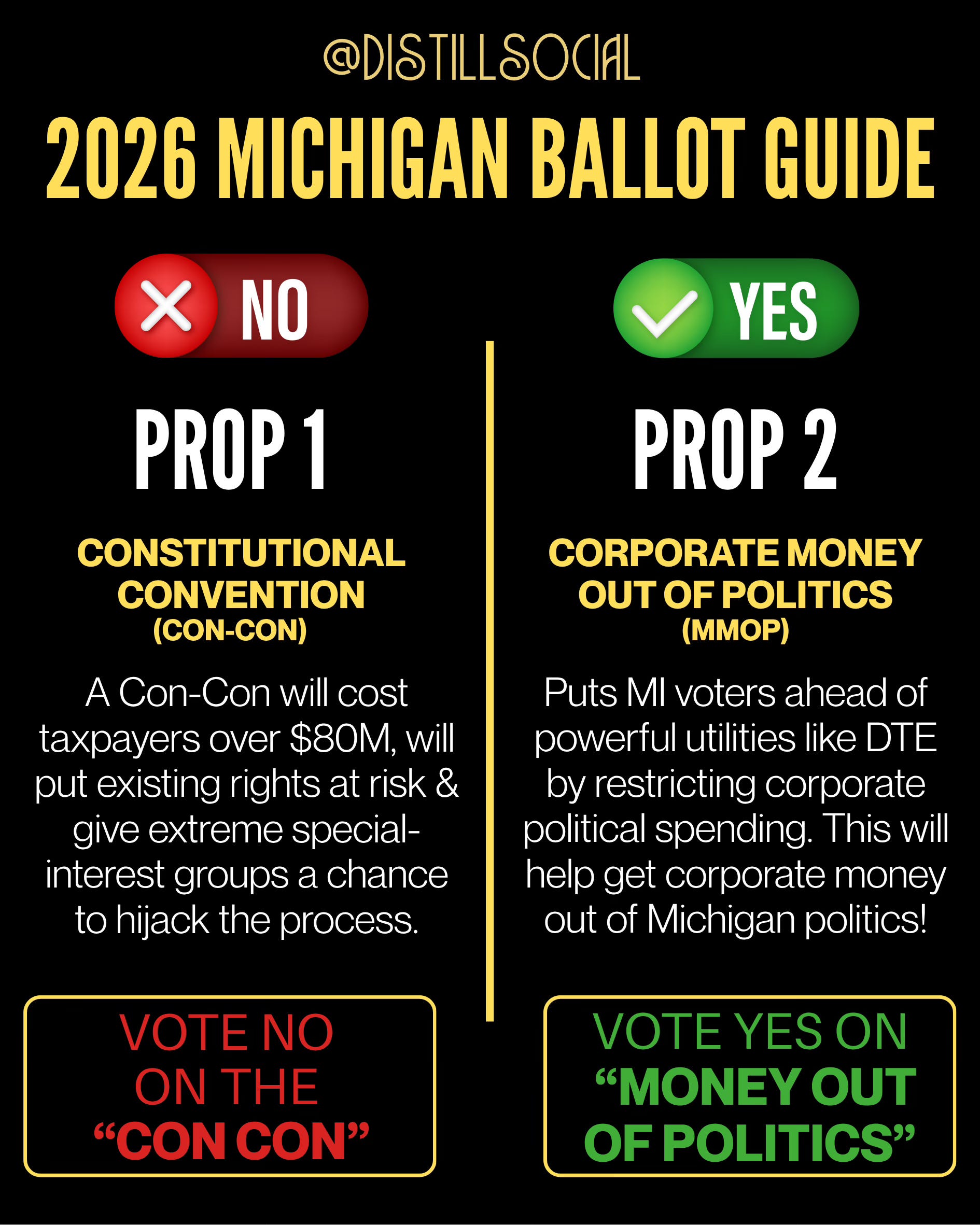
The waiting is over: Michigan’s 2026 general election ballot is officially set, and voters statewide will see two proposals this November. And these aren’t really left-versus-right issue, they’re about who gets to write the rules and how much influence powerful interests should have over our government, things most of us will agree on! Proposal 1 asks whether Michigan should open its Constitution to a broad rewrite, while Proposal 2 would restrict certain political contributions from regulated utilities and major government contractors and increase campaign-finance transparency. Whatever your party, these are questions about accountability, transparency and keeping political power in the hands of Michigan voters.
Proposal 1: Opening Michigan’s Constitution Comes With Enormous Risk
Proposal 1 asks Michigan voters whether they want to call a Constitutional Convention, commonly called a Con-Con, to undertake a general revision of the Michigan Constitution. This question automatically appears on the ballot every 16 years, and Michigan voters have repeatedly declined to call a convention, including in 1978, 1994 and 2010.
And this is not a proposal to fix one outdated sentence or make one narrowly defined change.
A “general revision” means opening Michigan’s foundational governing document to potentially sweeping changes. A convention could revisit provisions dealing with voting and elections, reproductive freedom, civil rights, taxation, property rights, public pensions, collective bargaining, the powers of state government and much more.
That is what makes Proposal 1 so consequential.
If it passes, Michigan would hold partisan elections for 148 convention delegates — one from every state House and state Senate district. Those delegates would then meet in Lansing, choose their own leadership, establish their own rules and decide what changes to include in a proposed new constitution. The current Constitution does not set a fixed length for how long that convention could operate.
Voters would ultimately have to approve any revised constitution before it took effect. But by that point, the convention would have already determined which existing protections stay, which change and what new provisions voters are asked to accept as one constitutional package.
That creates a very different process from the way Michigan normally changes its Constitution.
Right now, voters can consider constitutional amendments one issue at a time. Michigan has repeatedly used that process to make targeted changes to voting rights, redistricting, term limits and other provisions without reopening the entire document. In 2022 we enshrined reproductive freedom into our state constitution this way.
A Constitutional Convention is the opposite: instead of fixing one provision, virtually everything can become part of the conversation.
That includes provisions Michiganders may currently take for granted.
The Citizens Research Council notes that a convention could debate issues involving equal protection, reproductive freedom, firearms regulation, voting rules, taxation, pensions, eminent domain and collective bargaining for state employees, among many others.
There is also a substantial financial cost. Independent estimates from the Citizens Research Council put the likely cost of a modern constitutional convention and related elections at roughly $70 million to $90 million, depending partly on how long the convention lasts.
So the question behind Proposal 1 is bigger than whether Michigan’s 1963 Constitution could be modernized.
It is whether the potential benefits of rewriting it justify opening decades of existing constitutional protections, governmental structures and voter-approved provisions to a broad political convention when Michigan already has a process for amending the Constitution one issue at a time. We say NO.
Proposal 2: Should the Companies We Regulate Be Funding the Politicians Regulating Them?
Proposal 2 targets a familiar problem in Michigan politics: companies that depend on decisions from state government can also spend money influencing the people making those decisions.
The proposal would restrict certain political contributions from regulated electric and gas utilities, including DTE and Consumers Energy, as well as companies receiving more than $250,000 a year in government contracts. The restrictions would also reach certain executives, board members and others closely connected to those companies.
The argument from supporters is simple: the companies being regulated shouldn’t be financially supporting the politicians responsible for regulating them.
That concern is especially relevant with Michigan’s monopoly utilities, which rely on state regulators for major decisions involving rates and investments while remaining deeply involved in state politics.
Proposal 2 also takes aim at political spending voters often can’t easily trace. It would expand disclosure requirements for certain “issue ads” that mention candidates or ballot proposals close to an election, even when they avoid explicitly saying “vote for” or “vote against.”
It would not eliminate all dark money or outside political spending. Instead, it focuses on pay-to-play concerns and greater transparency around who is spending money to influence Michigan elections.
Opponents have raised First Amendment objections to some of the contribution restrictions, particularly those affecting individuals connected to regulated companies, and those questions could ultimately be tested in court.
At its core, Proposal 2 asks a pretty straightforward question:
Should companies that rely on government contracts or government regulators also be allowed to financially influence the officials on the other side of the table? We say NO!
Here’s the good news: these aren’t red-team-versus-blue-team issues. Nobody likes special interests messing with the rules, and pretty much everyone is tired of powerful corporations having an outsized voice in Lansing. So send this to your mom, your neighbor, your Republican cousin, your Democratic group chat and that one independent friend who complains about all politicians. Prop 1 and Prop 2 are exactly the kind of ballot questions we should all be talking about before Election Day. Finally something we can all agree on! Except DTE and a few other billion dollar corporations. 🤷
💥 Like this kind of content? Follow us on Instagram, Facebook, Twitter and check out our Facebook group: Michiganders for Freedom, Not Fascism — we’d love to haveyou join in the conversation!
👉 Click to download the Distill App in the App Store or Google Play. Let’s stay informed together.
Thanks 😊 for breaking it down!! I’m a MI voter
Thank you for laying this out on easy to understand terms!